
Sundarkand Chaupai and Doha: Famous Lines, Shlok and Samput
This page collects the most loved sundarkand chaupai lines, the opening shlok, the first and last doha, the dohas people search for by number (26 and 58), and the samput chaupais that families add to the path. Every line is in Devanagari with a simple meaning.
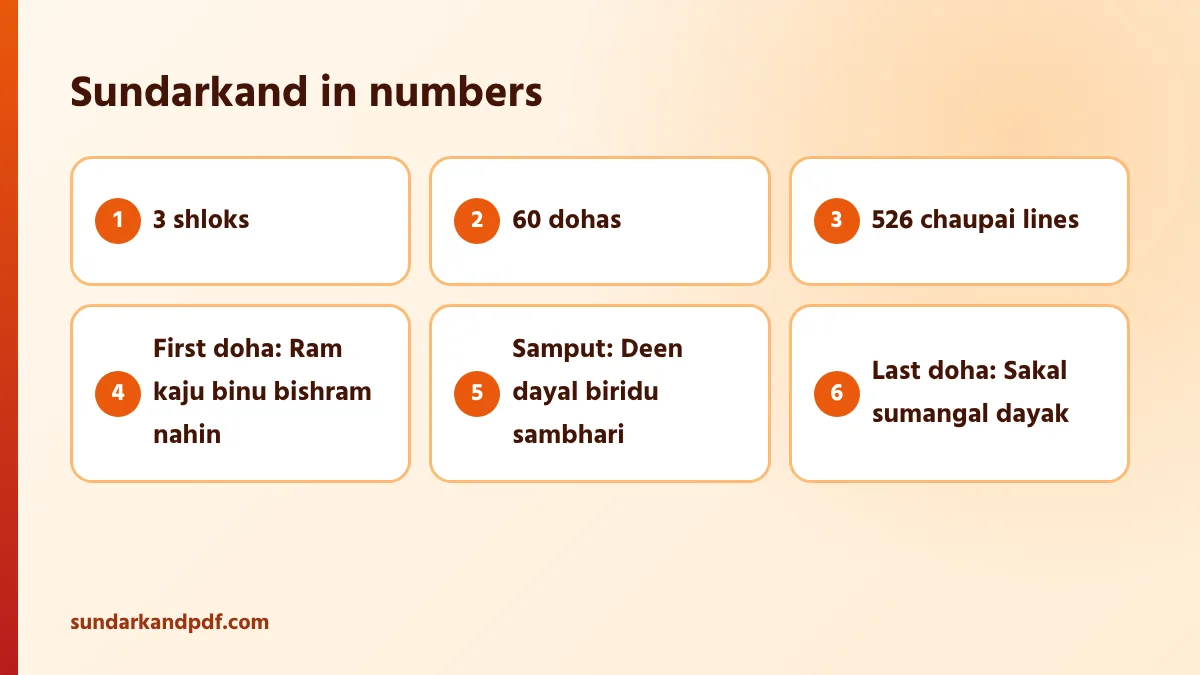
- Sundarkand has 3 shloks, 60 dohas and 526 chaupai lines.
- The first shlok is “Shantam shashvatam aprameyam anagham”.
- The first doha (Doha 1) ends “Ram kaju kinhen binu mohi kahan bishram”.
- A popular samput is “Deen dayal biridu sambhari, harahu nath mam sankat bhari”.
- The last doha (60) begins “Sakal sumangal dayak Raghunayak gun gaan”.
When people say “Sundarkand ki chaupai”, they usually mean a handful of lines that families repeat as prayers in daily life. Here they are, with their place in the text and their meaning.
For the complete text in order, read every Sundarkand doha and chaupai; for the meaning of each part, see Sundarkand with Hindi bhavarth.
📋 On this page
- How many dohas, chaupais and shloks are in Sundarkand?
- Sundarkand chaupai: the first shlok, first doha and first chaupai
- The most powerful and famous Sundarkand chaupai
- Sundarkand doha 26 and doha 58
- Samput for Sundarkand: how to use it
- Ek shloki Sundarkand
- Mantra before and after Sundarkand path
- Sundarkand chaupai and doha: searches answered
- Common mistakes to avoid
- Frequently asked questions
- Conclusion
How many dohas, chaupais and shloks are in Sundarkand?
| Part | Count |
|---|---|
| Shlok (Sanskrit, at the start) | 3 |
| Doha | 60 |
| Chaupai lines | 526 |
| Chhand | A few (in the Lanka dahan and ocean passages) |
| Soratha | A few, counted with the dohas in many editions |
| Adhyay / chapters | None; Sundarkand is one kand, divided only by doha numbers |
So if someone asks “sunderkand mein kitne dohe hote hain” or “how many chaupai in sunderkand”, the answer is 60 dohas and 526 chaupai lines. Different printers sometimes number one or two dohas differently, which is why you may see small differences.
Sundarkand chaupai: the first shlok, first doha and first chaupai
Meaning: I bow to Shri Ram, who is peaceful, eternal and beyond measure, served by Brahma, Shiva and Sheshnag, known through Vedanta. This is the pratham shlok of Sundarkand.
Meaning: Hanuman was delighted to hear Jambavant’s encouraging words. This is the first chaupai of Sundarkand.
Meaning: Hanuman touched Mainak with his hand and bowed: how can I rest before finishing Ram’s work?
🐦 Tweet this
The most powerful and famous Sundarkand chaupai
Meaning: Enter the city and do all your work keeping Ram in your heart. Recited before exams, travel and new beginnings.
Meaning: Then Sita’s heart felt reassured, and Hanuman took a small form again.
Meaning: O merciful Lord, remember your name of being kind to the humble, and remove my great trouble. This is the most used samput chaupai.
Meaning: Listen, Hanuman: no god, man or sage in a body has helped me as you have. Ram’s words to Hanuman.
Meaning: Hanuman began to sing Ram’s virtues, and hearing them, Sita’s sorrow fled.
Sundarkand doha 26 and doha 58
Meaning: After putting out his tail, shedding his tiredness and taking a small form again, Hanuman stood before Janaki (Sita) with folded hands. This doha comes right after Lanka dahan.
Meaning: A banana plant bears fruit only when cut, however much you water it; humility does not work with the wicked, they bend only when scolded. Kakbhushundi says this to Garud in the ocean episode.
Samput for Sundarkand: how to use it
A samput is a chaupai or mantra that is recited before and after every doha (or every few dohas) throughout the path, like a frame around each part. Families choose a samput based on their prayer.
| Samput | Used for |
|---|---|
| “Deen dayal biridu sambhari, harahu nath mam sankat bhari” | Removing trouble (sankat) |
| “Prabisi nagar kije sab kaja, hriday rakhi Kausalpur raja” | Success in work |
| “Mangal bhavan amangal hari, dravau so Dasarath ajir bihari” (from Bal Kand) | Auspicious beginnings, general well-being |
| “Ram kaju kinhen binu mohi kahan bishram” | Determination |
- Choose one samputDo not mix several in one path.
- Recite it at the startBefore the first shlok, say the samput once.
- Repeat after each dohaOr after every five dohas if time is short.
- End with itSay the samput once more before aarti.
Ek shloki Sundarkand
“Ek shloki Sundarkand” is a single Sanskrit verse that sums up the whole Sundara Kanda: Hanuman crosses the ocean, finds Sita, destroys the garden and the demons, burns Lanka and returns. It is recited by people who cannot do the full path, but it is not a replacement for a vow (sankalp) of the full path.
Meaning: I worship that Ramchandra, by whose grace Hanuman playfully crossed the ocean, reached Lanka, found Ram’s beloved Sita, broke the garden, killed Akshay and other demons, saw ten-headed Ravan, burned his city, crossed back and, with the monkeys, bowed to Ram.
Mantra before and after Sundarkand path
- Sankalp mantra: take water in your right hand and state your name, gotra, place, date and your wish, then say “Shri Hanumat prityartham Sundarkand path aham karishye”.
- Avahan: invite Hanuman ji with “Atulitbaldhamam hemshailabhdeham…” (the third shlok) or the Hanuman Chalisa opening doha.
- Havan mantra: in a havan, families offer ahuti after each doha with “Om Hanumate namah swaha”.
- Visarjan: after aarti, end with the last doha “Sakal sumangal dayak…” and a prayer for forgiveness of any mistakes.
These steps follow common family practice; your pandit may use a slightly different form. The full method is on the Sundarkand path vidhi page.
Sundarkand chaupai and doha: searches answered
- “Sundarkand chaupai”, “sunderkand chaupaiyan”, “sundar kand chaupai in hindi”, “sunderkand chaupai lyrics”, “sunderkand chaupai lyrics in hindi”, “sunderkand ki chaupai likhit mein”, “sunderkand all chaupai”, “sunderkand ki puri chaupai”, “ramcharitmanas sunderkand chaupai”, “ramayan chaupai sundar kand”, “ramayan sunderkand chaupai in hindi”, “ramayan sunderkand path chaupai”, “sunderkand paath chaupai” and “sunderkand doha chaupai”: all chaupais in order are on the lyrics page; the famous ones are above.
- “Sundar kand chaupai pdf”, “sunderkand chaupai in hindi pdf”, “sunderkand doha pdf”, “sunderkand ke dohe pdf”, “sunderkand 60 dohe pdf in hindi”, “sunderkand chaupai download”, “sunderkand shlok pdf”, “sunderkand mantra pdf”, “sunderkand mantra pdf in hindi”, “sunderkand ke samput pdf” and “ek shloki sunderkand pdf”: the Hindi PDF on the homepage contains every doha, chaupai and shlok; the samput and ek shloki text are on this page to copy.
- “Sundarkand doha”, “sunderkand ke dohe”, “sunderkand dohe in hindi”, “sunderkand doha in hindi”, “sunderkand dohe lyrics”, “sunderkand doha lyrics”, “sunderkand all doha”, “sunderkand ke 60 dohe”, “sunderkand 60 doha”, “ramcharitmanas sunderkand doha”, “sunderkand path doha”, “sunderkand ke sath dohe”, “sunderkand ke dohe aur chaupai”, “sunderkand chaupai ke sath”, “sunderkand 10 doha” and “sunderkand ke 5 dohe”: there are 60 dohas; any set of 5 or 10 dohas makes a good daily portion.
- “How many doha in sunderkand”, “how many dohas in sunderkand”, “how much doha in sunderkand”, “how many dohas are there in sunderkand”, “how many doha are there in sunderkand”, “number of dohas in sunderkand”, “number of doha in sunderkand”, “number of dohe in sunderkand”, “no of doha in sunderkand”, “total no of doha in sunderkand”, “sunderkand total doha”, “sundar kand total dohe”, “sunderkand how many dohe”, “how many chaupai in sunderkand”, “how many chaupai are there in sunderkand”, “number of chaupai in sunderkand”, “sunderkand total chaupai”, “sunderkand total shlok” and “how many doha and shlok are in sundar kand”: 60 dohas, 526 chaupai lines and 3 shloks.
- “Sundar kand doha 26”, “sunderkand doha number 26”, “sundar kand doha no 26”, “sunderkand ki chaupai doha number 26”, “sundar kand doha no 58”, “sunderkand 58 doha” and “sunderkand doha 58 in hindi”: both are shown above with meaning.
- “Sunderkand ka pahla doha”, “sunderkand ka pehla doha”, “sunderkand ki pahli chaupai”, “sunderkand ki pratham chaupai”, “sunderkand first chaupai”, “sunderkand ka pahla shlok”, “sunderkand ka pehla shlok”, “sunderkand ka pratham shlok”, “sunderkand first shlok”, “sunderkand last doha” and “sunderkand last chaupai”: first shlok, first chaupai and first doha are above; the last doha is “Sakal sumangal dayak”, and the last chaupai lines before it praise the Raghupati gun gaan.
- “Sunderkand best chaupai”, “sunderkand best chaupai in hindi”, “sunderkand famous chaupai”, “sunderkand famous chaupai in hindi”, “sunderkand ki sundar chaupai”, “sunderkand ki pramukh chaupaiyan”, “sunderkand important chaupai”, “sunderkand siddh chaupai”, “sunderkand powerful chaupai”, “sunderkand ki sabse powerful chaupai”, “hanuman ji chaupai sunderkand”, “sunderkand ki 10 chaupai”, “sunderkand ki 11 chaupai”, “sunderkand 35 chaupai”, “famous sunderkand dohas” and “important doha from sunderkand to chant”: the five famous chaupais and two dohas above are the ones most families treat as siddh (proven by tradition).
- “Samput for sunderkand”, “sunderkand ke liye samput”, “sunderkand samput chaupai”, “sunderkand samput in hindi”, “sunderkand samput path”, “best samput for sunderkand”, “all samput of sunderkand”, “samput for sunderkand of ramayan in hindi” and “samput for sunderkand or ramayan in hindi”: see the samput table and steps above.
- “Ek shloki sunderkand”, “ek shloki sunderkand in hindi” and “ek shloki sunderkand lyrics”: the full verse and its meaning are above.
- “Sundar kand shlok”, “sunderkand shlok in hindi”, “sunderkand shlok lyrics”, “ramcharitmanas sunderkand shlok” and “pancham sopan sunderkand shlok”: the three opening shloks are on the lyrics page.
- “Sundar kand mantra”, “sunderkand mantra in hindi”, “sunderkand mantra text”, “sunderkand powerful mantra”, “chant this mantra from sunderkand”, “mantra to recite before sunderkand”, “sunderkand avahan mantra”, “sunderkand sankalp mantra”, “sunderkand havan mantra” and “sunderkand visarjan mantra”: see the mantra section above.
- “Sunderkand chhand”: chhands appear in the Lanka dahan and ocean passages.
- “Sunderkand chaupai image” and “images of chaupai of sunderkand”: the text above is clearer than images and easy to copy.
- “Sunderkand 41 chaupai to 49 chaupai” and “sunderkand mandir doha”: the Vibhishan sharnagati dohas 41 to 49 are often read on their own in temples.
Common mistakes to avoid
- Quoting lines from Bal Kand or Hanuman Chalisa as if they were from Sundarkand.
- Mixing several samputs in one path.
- Changing the words of a chaupai to make it “easier”; read it as written.
- Assuming a single siddh chaupai replaces a full path vow.
Frequently asked questions
How many dohas are in Sundarkand?
Sundarkand has 60 dohas, along with 526 chaupai lines and 3 Sanskrit shloks at the start.
Which is the most powerful chaupai of Sundarkand?
Families most often use “Prabisi nagar kije sab kaja” before any work and “Deen dayal biridu sambhari” in times of trouble. Power here is a matter of faith and tradition.
What is the first doha of Sundarkand?
“Hanuman tehi parasa kar puni kinh pranam, Ram kaju kinhen binu mohi kahan bishram”: Hanuman refuses to rest until Ram’s work is done.
What is a samput in Sundarkand path?
A samput is a chosen chaupai repeated before and after each doha or group of dohas, framing the whole path with one prayer.
What is ek shloki Sundarkand?
It is a single Sanskrit shloka that sums up the entire Sundara Kanda, recited when the full path is not possible.
What does doha 26 of Sundarkand say?
After burning Lanka and putting out his tail, Hanuman takes a small form and stands before Sita with folded hands.
Conclusion
These Sundarkand chaupai, dohas and shloks are the heart of the path. Learn two or three by heart, choose one samput for your vow, and read the full text in order when you can.
Next step: practise “Prabisi nagar kije sab kaja” before your next task, then read how much time a full Sundarkand path needs.