Sundar Kand in English
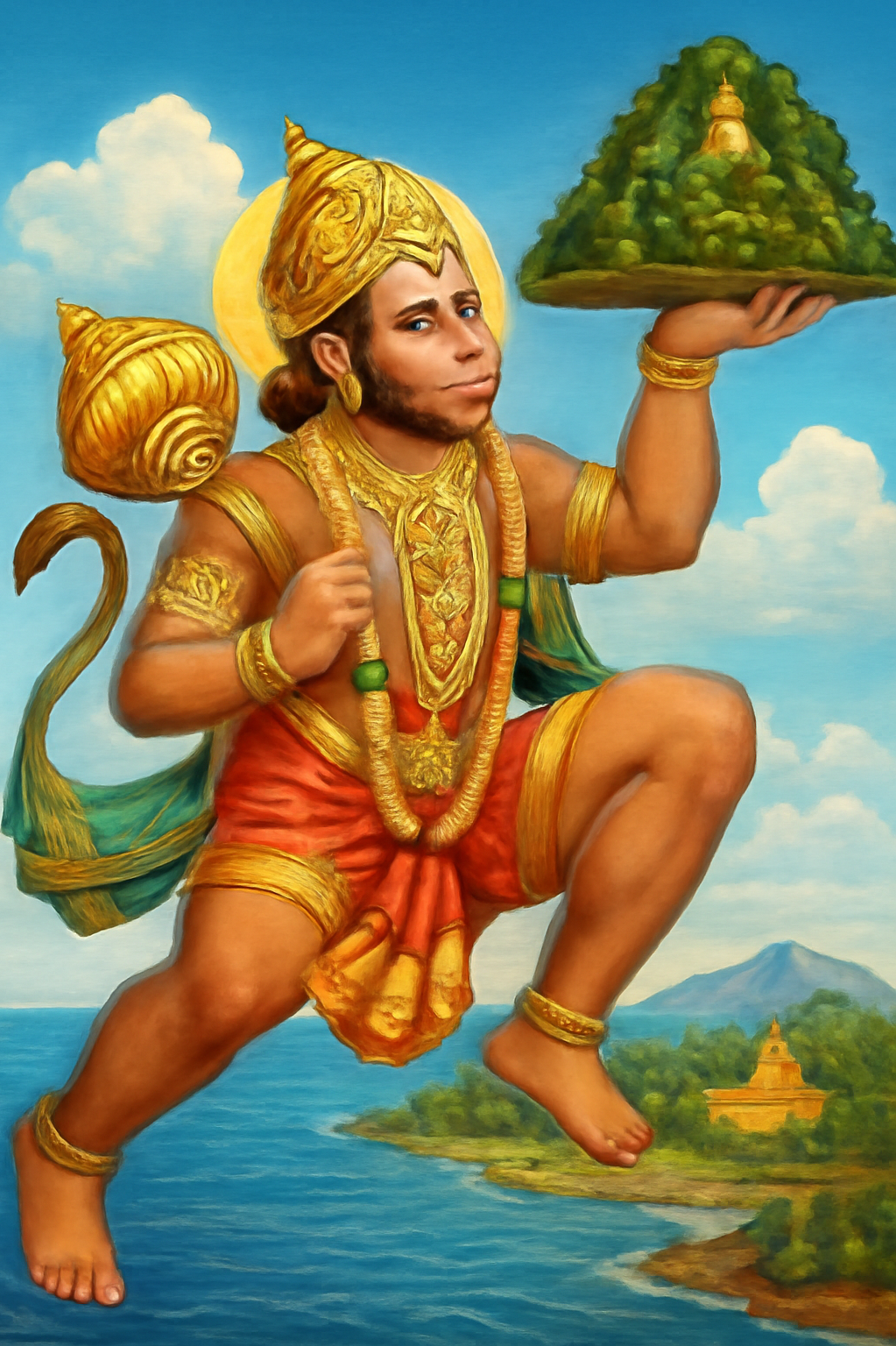
Sundar Kand is one of the most revered chapters in the Indian epic Ramayana, written by Sage Valmiki. This section stands out not only for its narrative style but also for the profound spiritual and philosophical messages it conveys. “Sundar” means “beautiful” in Sanskrit, and “Kand” refers to a “book” or “chapter,” making Sundar Kand the “Beautiful Chapter.” It is the fifth of seven books in the Ramayana and primarily focuses on Lord Hanuman, the devoted monkey god, and his adventures in Lanka.
Sundar Kand in English
In this chapter, Hanuman embarks on an extraordinary journey to find Sita, the wife of Lord Rama, who has been abducted by the demon king Ravana. Unlike other parts of the Ramayana that focus on battles or moral dilemmas, Sundar Kand highlights the themes of devotion, courage, and divine intervention. It is a celebration of Hanuman’s loyalty, bravery, and selfless service to Lord Rama. Hanuman’s journey is filled with challenges, each of which he overcomes through his unwavering faith in Rama and his own divine strength.
For devotees of Lord Hanuman, Sundar Kand is a source of inspiration, teaching that with faith and devotion, even the impossible can be achieved. The narrative emphasizes that true devotion to a higher cause often involves self-sacrifice and courage, and that the power of love and service is a path to spiritual fulfillment.
Sundar Kand is not only an essential text in the Ramayana but also plays a central role in the religious and cultural practices of millions. The recitation of this chapter is considered auspicious, and it is believed to bring peace, prosperity, and protection from evil.
The Setting of Sundar Kand
The events in Sundar Kand take place after the abduction of Sita by Ravana. Lord Rama, accompanied by his brother Lakshman and the vanara (monkey) army, has already crossed many significant milestones in his search for Sita. The primary focus of Sundar Kand, however, is Hanuman’s monumental journey to Lanka in order to locate Sita and deliver Lord Rama’s message.
In the Ramayana, after Ravana kidnaps Sita, he takes her to his kingdom of Lanka, a prosperous but morally corrupt place. Sita, in her captivity, refuses Ravana’s advances and remains steadfast in her devotion to Rama. On the other side, Rama, along with Lakshman, searches for Sita but encounters many obstacles in his quest. Eventually, the vanara king, Sugriva, and his loyal general Hanuman offer their help to Rama.
Hanuman, whose devotion to Rama is unmatched, is given the task of finding Sita. The journey is far from easy, as it involves crossing the vast ocean that separates the Indian subcontinent from Lanka. The ocean symbolizes the immense challenge of crossing one’s own limitations, both physical and spiritual. It is here that Hanuman’s character is truly tested. As a divine being with extraordinary powers, he faces doubts, but his determination and devotion to Rama allow him to succeed in his mission.
The vastness of the journey underscores the scale of the task at hand, and it serves as a metaphor for the spiritual journey that devotees must undertake. The ocean, in this sense, is not just a physical barrier but also a psychological one, representing the doubts and fears that one must overcome in order to achieve higher goals.
Key Characters in Sundar Kand
1. Hanuman
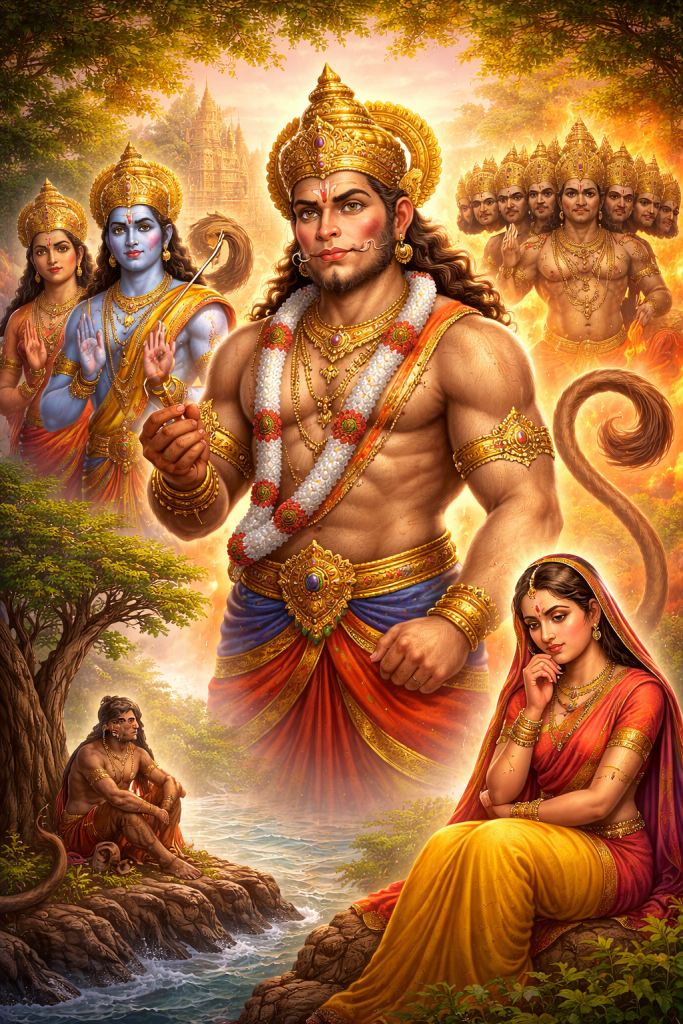
Hanuman is one of the most beloved deities in Hinduism, known for his immense strength, courage, and devotion. He is the son of the wind god, Vayu, and Anjana, a celestial nymph. Hanuman is a monkey-faced deity who embodies selfless devotion and unwavering loyalty, particularly to Lord Rama. His role in Sundar Kand is pivotal, as he is the one who takes the responsibility of locating Sita and delivering Rama’s message. Hanuman’s powers are extraordinary—he can change his size, leap across oceans, and destroy entire armies. But it is his devotion to Rama that makes him truly powerful. His faith in Rama’s divine mission allows him to perform miracles that help bring about the ultimate victory of good over evil.
In Sundar Kand, Hanuman demonstrates all the qualities of a true devotee: humility, courage, and self-sacrifice. His journey is not just about physical feats but also about spiritual growth. As he crosses the ocean and enters Lanka, he faces numerous challenges, but his focus remains unwavering. His encounter with Sita in Lanka is one of the most touching moments in the Ramayana, symbolizing the strength of his devotion and the divine connection between Lord Rama and Sita.
2. Rama
Lord Rama, the seventh incarnation of Lord Vishnu, is the protagonist of the Ramayana. He is the prince of Ayodhya, known for his righteousness, bravery, and sense of justice. Rama’s role in Sundar Kand is more passive, as he gives the task of locating Sita to Hanuman. However, his trust in Hanuman and his unshakable resolve to rescue Sita are key elements that drive the narrative forward. Rama’s character serves as a moral compass in the Ramayana, and his unwavering commitment to truth and dharma (righteousness) is central to the themes of the Ramayana.
Rama’s leadership is demonstrated through his calmness and wisdom, even in the face of adversity. He does not let anger or desperation cloud his judgment and instead focuses on strategic action, exemplifying the importance of patience and thoughtfulness in the face of difficulty. His relationship with Hanuman is one of deep mutual respect and affection, and it is through Rama’s guidance that Hanuman finds the strength to undertake his heroic mission.
3. Sita
Sita, the wife of Lord Rama, is a symbol of purity, devotion, and strength. Her abduction by Ravana sets the stage for the events of Sundar Kand. While she remains largely a passive character in this section, her presence is central to the story. Despite her captivity in Lanka, Sita remains faithful to Rama and rejects Ravana’s advances. Her character is a representation of the ideal wife and woman, whose devotion to her husband never falters, even in the face of grave danger.
Sita’s plight and her resolve highlight the importance of virtue and moral strength. Her reunion with Rama at the end of the Ramayana symbolizes the restoration of righteousness and order, a theme that is echoed throughout the text.
4. Ravana
Ravana, the ten-headed demon king of Lanka, is the primary antagonist of the Ramayana. Although he plays a more prominent role in other parts of the Ramayana, his presence is felt throughout Sundar Kand. Ravana’s abduction of Sita and his attempts to seduce her serve as the catalyst for the entire conflict. Ravana is a complex character—he is a powerful king, learned in the scriptures, but his pride and arrogance ultimately lead to his downfall. Ravana’s decision to abduct Sita, despite warnings from his advisors, is a key example of how his ego clouds his judgment.
In Sundar Kand, Ravana’s forces capture Hanuman, but they fail to understand the true strength of their prisoner. Hanuman’s escape, followed by the destruction of Lanka, is symbolic of the inevitable destruction that comes from hubris and the rejection of dharma.
Plot of Sundar Kand
The plot of Sundar Kand centers around Hanuman’s mission to locate Sita and deliver a message from Lord Rama. The chapter is a crucial turning point in the Ramayana, as Hanuman’s actions pave the way for the eventual rescue of Sita and the victory over Ravana. The plot can be broken down into several key episodes:
1. Hanuman’s Departure from Kishkindha
Hanuman, along with other vanaras (monkey warriors), had already been searching for Sita across the forest regions of India. When it becomes clear that they are unable to locate her, Rama, who is still in exile, turns to Hanuman, his most trusted ally. Rama asks Hanuman to find Sita and assures him that he will be greatly rewarded for his service.
Hanuman, who already possesses immense strength and supernatural abilities, is not deterred by the magnitude of the task. He is eager to fulfill Rama’s command and begins preparing for the journey to Lanka. Before he departs, he is encouraged and blessed by his friends and mentors, including Sugriva, the vanara king, and Jambavan, the wise old bear. Hanuman’s journey symbolizes the internal call to duty and righteousness, a theme that is consistent throughout the Ramayana.
2. Crossing the Ocean
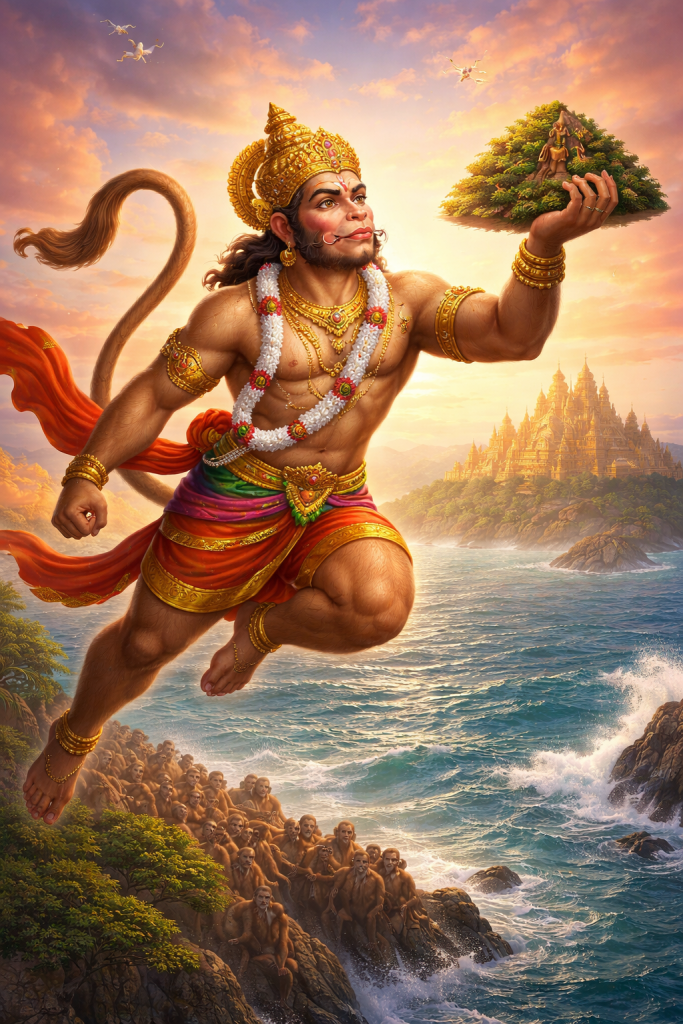
One of the most famous moments in Sundar Kand is Hanuman’s leap across the ocean to Lanka. The ocean represents a vast barrier, both physically and metaphorically. In the text, it is described as an impossible challenge, but Hanuman’s divine powers allow him to overcome it. As he begins his leap, he recalls his own strength and the blessings of Rama, which grant him the courage to face this formidable obstacle.
Hanuman’s leap is a powerful symbol of faith, determination, and the triumph of the spirit over the physical realm. It highlights that with complete devotion to a higher purpose, one can overcome even the most seemingly insurmountable challenges. His journey across the ocean is also a metaphor for the challenges people face in life—whether they be spiritual, emotional, or physical—and how faith in oneself and a higher power can help one navigate them.
3. Arrival in Lanka
Upon arriving in Lanka, Hanuman begins searching for Sita. The city of Lanka, with its grandeur and opulence, is described as a place of great beauty and wealth. However, it is also a city of moral decay, where Ravana, the demon king, holds sway. Hanuman’s search for Sita takes him to the gardens, palaces, and temples of the city, but his first encounter with Ravana’s forces does not yield any results.
Hanuman’s encounter with Ravana’s soldiers and his subsequent capture are important turning points in the plot. While trying to locate Sita, Hanuman is caught by the demons who work for Ravana. They bring him before the king, who orders that Hanuman be bound and brought before him. However, despite being captured, Hanuman remains calm and composed. He refuses to reveal his true identity, knowing that his mission is not yet complete.
4. Meeting Sita in Ashoka Vatika
Hanuman’s first direct interaction with Sita occurs in the Ashoka Vatika (the Ashoka garden), where she is being held captive by Ravana. Sita is sitting under a tree, grieving for her husband Rama, when Hanuman finds her. Recognizing her as the queen of Rama, Hanuman approaches her cautiously and introduces himself as a messenger of Rama.
In a moment filled with emotion, Hanuman reassures Sita that Rama is alive and is actively searching for her. He presents Rama’s ring to her as a token, further solidifying his claims. Hanuman’s meeting with Sita symbolizes the connection between Rama and his devoted servant. Sita, in turn, is comforted by the news that Rama will rescue her.
Hanuman’s presence in Ashoka Vatika also symbolizes the divine intervention that often occurs at moments of great distress. In a sense, Hanuman acts as a bridge between the material world and the divine, bringing Rama’s message of hope and assurance.
5. Hanuman’s Capture and Escape
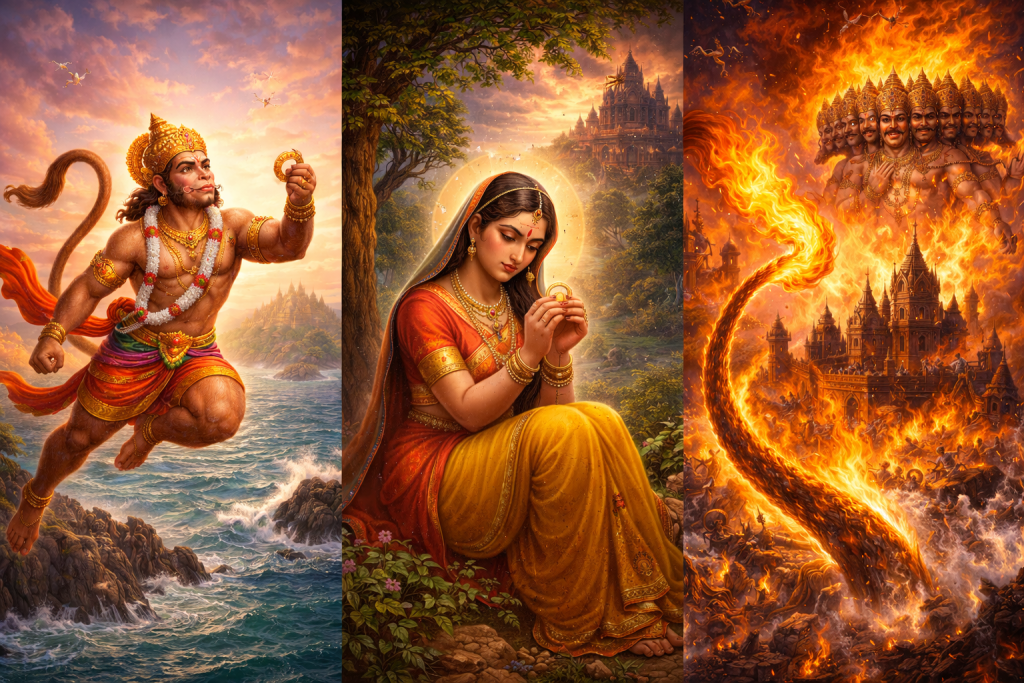
After Hanuman delivers Rama’s message to Sita, he is captured by Ravana’s forces. They attempt to humiliate him by tying him up and parading him through the streets of Lanka. However, Hanuman’s divine powers allow him to escape from his bonds. In a dramatic moment, he sets fire to the city of Lanka using his burning tail, which he had wrapped in cloth.
The fire symbolizes the destruction of evil and ignorance. Hanuman’s escape, followed by the destruction of parts of Lanka, is a precursor to Ravana’s eventual defeat. It signifies that the forces of righteousness (represented by Rama and his followers) will ultimately prevail over the forces of evil (represented by Ravana and his kingdom). Hanuman’s act of setting fire to Lanka is not just a physical act of destruction; it is also symbolic of the destruction of the ego and ignorance that prevent spiritual progress.
6. Return to Rama
After his escape from Lanka, Hanuman returns to Rama with the news of his successful mission. He brings back details about Sita’s location, her condition, and the state of Ravana’s kingdom. The vanara army, led by Rama, is now prepared to launch an assault on Lanka to rescue Sita.
Hanuman’s return marks the completion of his mission, but his journey is far from over. The events of Sundar Kand set the stage for the epic battle between Rama and Ravana, which will culminate in Ravana’s defeat and the restoration of dharma.
Major Themes in Sundar Kand
1. Devotion (Bhakti)
The most prominent theme in Sundar Kand is devotion, particularly the unwavering bhakti (devotion) of Hanuman to Lord Rama. Hanuman’s actions throughout the chapter are motivated by his deep love and faith in Rama. His willingness to risk his life, journey across vast oceans, and face insurmountable obstacles all stem from his devotion to Rama. The importance of bhakti is clear—true devotion to a higher power can lead to miraculous feats and a greater understanding of the self.
Hanuman’s devotion teaches that love and service to the divine are not just acts of worship; they are ways of living. By acting in service to Rama, Hanuman transcends his physical limitations and becomes a model of ideal devotion.
2. Strength and Courage
Another key theme in Sundar Kand is strength, both physical and spiritual. Hanuman’s physical strength is legendary—he is able to carry mountains, leap across oceans, and defeat powerful demons. However, it is his spiritual strength that truly sets him apart. His unwavering belief in Rama and his understanding of his own divine nature give him the courage to face challenges that would seem insurmountable to others.
In life, true strength comes from the ability to overcome fear and doubt, and Hanuman embodies this idea perfectly. His strength is not simply a physical attribute but also a reflection of his inner character and spiritual resolve.
3. Self-Sacrifice
Hanuman’s journey in Sundar Kand is also a lesson in self-sacrifice. He does not hesitate to put his own life at risk for the sake of Rama and Sita. His mission is not driven by the desire for glory or recognition, but by the selfless need to serve his master. Hanuman’s selflessness teaches that true service is not about personal gain but about contributing to a higher cause.
This theme resonates in a world where people often seek personal gain or recognition. Hanuman’s actions remind us that true fulfillment comes from serving others without expectation of reward.
4. Victory of Good over Evil
The ultimate message of the Ramayana, and particularly in Sundar Kand, is the victory of good over evil. While Ravana’s forces seem powerful and invincible, the moral and spiritual strength of Hanuman, Rama, and their allies ensures that righteousness will prevail. Hanuman’s actions, from crossing the ocean to setting fire to Lanka, highlight that no matter how dark the world may seem, divine intervention and righteous action will eventually triumph.
This theme is a central part of Hindu mythology and underscores the importance of maintaining dharma (righteousness) in the face of adversity. Hanuman’s heroism in Sundar Kand serves as a testament to the fact that good will always prevail in the end.
Symbolism and Allegory in Sundar Kand
1. Hanuman’s Leap Across the Ocean
Hanuman’s leap across the ocean to Lanka is one of the most iconic moments in the Ramayana and is laden with symbolism. The ocean represents not just a physical barrier, but also the obstacles and doubts that one must overcome in the pursuit of a greater purpose. The ocean is vast and seemingly insurmountable, much like the challenges we face in life. However, Hanuman’s leap shows that with faith and determination, these challenges can be overcome.
The leap symbolizes the crossing of one’s own limitations—whether they be fear, doubt, or worldly attachments—and moving toward spiritual fulfillment. Hanuman’s ability to leap across the ocean with ease reflects his deep connection with the divine, suggesting that the physical realm can be transcended with devotion and grace.
2. The Burning of Lanka
The burning of Lanka is one of the most dramatic moments in Sundar Kand. Hanuman’s tail, which is set on fire as a punishment by Ravana’s soldiers, becomes a tool of destruction as Hanuman burns down parts of the city. The fire represents the purification of evil, the burning away of ignorance, and the destruction of falsehood.
In a more spiritual sense, the fire also symbolizes the transformative power of divine grace. Just as fire transforms whatever it touches, the divine light (represented by Rama and Hanuman) purifies the hearts of those who are devoted and ready to receive it.
Lessons from Sundar Kand
1. The Power of Faith
One of the key lessons from Sundar Kand is the power of faith. Hanuman’s unwavering belief in Rama allows him to perform miracles. His leap across the ocean, his meeting with Sita, and his escape from Lanka are all made possible by his absolute faith in the divine mission. This lesson teaches that with faith in oneself and a higher power, no task is too great.
2. Overcoming Doubts and Fears
Hanuman’s journey also teaches how to overcome doubts and fears. At several points in his journey, Hanuman faces daunting challenges, from crossing the ocean to being captured by Ravana’s soldiers. However, his faith and inner strength allow him to rise above these fears. The story reminds us that self-doubt and fear are often the greatest obstacles to success, and overcoming them is essential for spiritual and personal growth.
3. Service Above Self
Another important lesson is the concept of selfless service. Hanuman’s actions are driven by his desire to serve Rama without seeking any personal rewards. His life is an example of how true service to others can lead to fulfillment and spiritual growth.
4. Spiritual Growth
Finally, Sundar Kand is a lesson in spiritual growth. Hanuman’s journey is not just about physical feats but also about his evolution as a spiritual being. As he serves Rama and faces obstacles, he becomes more connected with the divine and achieves higher spiritual understanding. This teaches that our trials and challenges can also be a path to personal transformation and spiritual awakening.
Sundar Kand in Modern Context

In today’s fast-paced, modern world, Sundar Kand continues to resonate deeply with people across different cultures and backgrounds. The ancient wisdom encapsulated in this chapter of the Ramayana provides timeless lessons that are applicable to contemporary life. The primary themes of devotion, courage, and overcoming obstacles remain incredibly relevant in today’s world.
Relevance Today
The story of Hanuman’s devotion and selfless service to Lord Rama serves as an inspiration to millions. In a world full of challenges, Sundar Kand teaches us that no matter the difficulties we face, faith and commitment to a greater purpose can help us navigate the hardest times. Just as Hanuman was able to perform feats that seemed impossible, people today are encouraged to look beyond their limitations and strive to achieve what might seem unattainable.
The concept of overcoming barriers—both external and internal—remains a central message in modern life. Whether these barriers are personal doubts, societal expectations, or global issues, Sundar Kand encourages individuals to tap into their inner strength and devotion, just as Hanuman did. In a modern context, this might translate into developing resilience, fighting for justice, or contributing positively to society, all while maintaining humility and selflessness.
Furthermore, the teachings of Sundar Kand are not only about the physical acts of devotion but also about cultivating an inner spiritual life. In a world where materialism often dominates, the chapter calls for spiritual alignment and emphasizes the importance of connection with the divine through service and faith.
Hanuman as a Symbol in Modern Times
Today, Hanuman is not just a mythological figure, but a universal symbol of strength, perseverance, and unwavering faith. His image appears in various forms of modern art, literature, and even pop culture. Hanuman’s strength and determination to serve Rama without self-interest resonate strongly with many, particularly in leadership, sports, and motivational contexts.
In India, especially, Hanuman continues to be worshipped with great devotion, and his influence extends beyond religious circles. He is often invoked by individuals facing personal struggles or needing to overcome significant challenges in life. His characteristics of strength, humility, and loyalty are qualities that are admired in modern society, and his stories inspire people to push forward, regardless of the obstacles in their path.
Recitation and Rituals of Sundar Kand
Sundar Kand is not only a literary masterpiece but also holds significant ritual and spiritual importance in Hindu practices. Its recitation and rituals associated with it are deeply ingrained in the religious and cultural fabric of India and beyond.
Recitation of Sundar Kand
Reciting Sundar Kand is considered auspicious and is believed to bring peace, prosperity, and protection from evil forces. Devotees often recite or listen to this chapter during Hanuman Jayanti (the birthday of Lord Hanuman), as well as during other festivals and religious events. The recitation of Sundar Kand is said to purify the mind and soul and help devotees overcome obstacles in life.
The rhythmic chanting of the verses, often performed by devotees in temples or during personal worship, serves as a reminder of Hanuman’s devotion and the power of faith. For many, the act of reciting Sundar Kand is not just a religious ritual, but a personal meditation that strengthens their connection to the divine.
It is also common for families and communities to gather together and recite Sundar Kand as a collective act of devotion. This communal recitation strengthens social bonds and helps foster a sense of unity and spiritual growth.
Hanuman Puja and Sundar Kand
Hanuman Puja (worship) is a common practice for devotees who wish to invoke the blessings of Lord Hanuman. Sundar Kand is often recited during this puja as it emphasizes Hanuman’s unwavering faith, loyalty, and divine strength. The prayer helps to invite positive energy and ward off negative forces, while also providing spiritual upliftment. During Hanuman Puja, offerings of sweets, flowers, and incense are made, and the chanting of Sundar Kand is an essential part of the ceremony.
In addition, many believe that chanting the chapter daily can remove mental, physical, and emotional obstacles. The ritual is considered a spiritual practice that purifies the devotee’s heart and mind, aligning them with the divine energy.
Special Occasions for Recitation
Sundar Kand is also recited on various special occasions, such as:
- Hanuman Jayanti: The birthday of Lord Hanuman, celebrated with great devotion across India and in other parts of the world. On this day, recitations of Sundar Kand are common as a form of gratitude to Hanuman.
- During Personal Challenges: Many devotees recite Sundar Kand when they face personal hardships or need strength and guidance. The chapter’s theme of overcoming insurmountable obstacles provides solace during difficult times.
- Festivals and Religious Gatherings: Sundar Kand is often recited during religious festivals such as Diwali, Ram Navami, or Navaratri, where its spiritual teachings are shared among large groups of people.
Cultural and Religious Significance of Sundar Kand
Sundar Kand holds immense cultural and religious importance, particularly within Hinduism. It is not only a beloved text in the Ramayana, but it is also central to the practice of Bhakti (devotion). The chapter’s profound teachings have transcended time, making it an important cultural text across generations.
Sundar Kand’s Influence on Art and Culture
Sundar Kand has inspired countless forms of art, from traditional painting and sculpture to contemporary music and dance. The epic story of Hanuman’s devotion has been depicted in various classical dance forms, including Bharatanatyam, Odissi, and Kathak. Artists and musicians have also composed bhajans (devotional songs) and kirtans (religious chants) based on the verses of Sundar Kand.
In folk traditions, Sundar Kand has been enacted in dramatic performances and street plays, where the story of Hanuman’s leap across the ocean and his encounter with Sita is brought to life for the audience. These performances are an important part of cultural celebrations, especially in rural areas, where people come together to celebrate Hanuman’s heroism and devotion.
The teachings of Sundar Kand have also inspired literature, with writers and poets often referencing its themes of faith, loyalty, and courage. It continues to be a popular subject in modern spiritual and motivational literature.
Sundar Kand and Its Global Impact
While Sundar Kand holds a central place in Hindu culture, its teachings have universal appeal. The themes of selflessness, devotion, and inner strength resonate with people of all faiths. In fact, Hanuman is worshipped by people from various religious traditions outside of Hinduism, including Jainism, Buddhism, and even in some regions of Southeast Asia.
The chapter’s universal message has also reached across the globe, particularly among people in the Indian diaspora. Communities around the world continue to celebrate Hanuman and recite Sundar Kand as a way to connect with their roots, celebrate their heritage, and seek spiritual solace.
Conclusion: The Enduring Legacy of Sundar Kand
Sundar Kand is a central part of the Ramayana that continues to inspire millions of people around the world. Its timeless themes of devotion, courage, and overcoming obstacles resonate deeply with individuals in today’s fast-paced, complex world. The chapter’s portrayal of Hanuman’s dedication, his selfless service to Lord Rama, and his ability to rise above fear and doubt serves as a guiding light for devotees and seekers of truth alike.
In a modern context, Sundar Kand reminds us that inner strength, devotion to a higher purpose, and selfless service can help us navigate the challenges of life. The story of Hanuman encourages us to cultivate faith, courage, and humility in our own journeys. Through devotion, perseverance, and trust in a higher power, we can achieve our goals and transcend the obstacles that stand in our way.
The recitation of Sundar Kand continues to be an important spiritual practice, offering solace, protection, and guidance to those who seek it. Whether through personal devotion or communal worship, the chapter holds a special place in the hearts of millions, ensuring its legacy lives on for generations to come.