
Sundarkand Ramayan: What Is Sundarkand in Ramcharitmanas and Who Wrote It
sundarkand ramayan means the Sundarkand chapter of the Ramayan. This page explains what Sundarkand is, where it sits in Ramcharitmanas and in Valmiki Ramayan, who wrote it, how it is divided, and why it is read more than any other part.
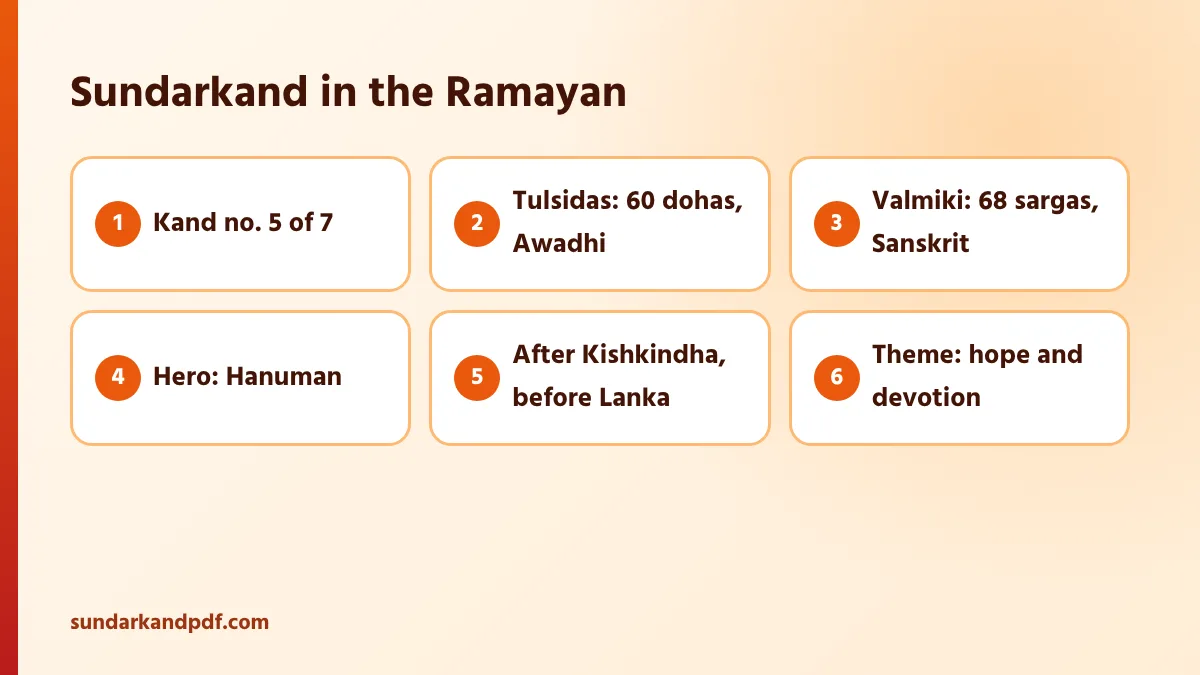
- Sundarkand is the fifth kand of the Ramayan, both in Valmiki Ramayan and in Tulsidas’ Ramcharitmanas.
- The Ramcharitmanas Sundarkand was written by Goswami Tulsidas in Awadhi; it has 60 dohas.
- Valmiki’s Sundara Kanda in Sanskrit has 68 sargas.
- It is about Hanuman’s journey to Lanka and back.
- It is not divided into adhyay; dohas are its units.
When people search for “Sundarkand Ramayan” they usually want three answers: what is it, who wrote it, and which part of the Ramayan it is. Here they are, clearly.
The complete text is on the full Sundarkand lyrics page, and the free Hindi book is on the Sundarkand PDF homepage.
📋 On this page
- Sundarkand Ramayan: which part of the Ramayan is it?
- What is Sundarkand about?
- Who wrote Sundarkand?
- How is Sundarkand divided? Parts, chapters and adhyay
- Why is Sundarkand the most read part of the Ramayan?
- More questions about Sundarkand in the Ramayan
- Sundarkand Ramayan: searches answered
- Common mistakes to avoid
- Frequently asked questions
- Conclusion
Sundarkand Ramayan: which part of the Ramayan is it?
| No. | Kand (Ramcharitmanas) | Main story |
|---|---|---|
| 1 | Bal Kand | Birth and childhood of Ram, Sita swayamvar |
| 2 | Ayodhya Kand | Exile of Ram |
| 3 | Aranya Kand | Forest life, Sita taken by Ravan |
| 4 | Kishkindha Kand | Friendship with Sugriv, search begins |
| 5 | Sundar Kand | Hanuman goes to Lanka and returns |
| 6 | Lanka Kand | The war and Ravan’s defeat |
| 7 | Uttar Kand | Return to Ayodhya, Ram rajya |
Sundarkand is the fifth part, called the Pancham Sopan (fifth step) of Shri Ramcharitmanas. In Valmiki Ramayan too it is the fifth book; the sixth is called Yuddha Kanda instead of Lanka Kand.
What is Sundarkand about?
Sundarkand tells how Hanuman, encouraged by Jambavant, leaps across the ocean to Lanka, finds Sita in Ashok Vatika, gives her Ram’s ring, burns Lanka, returns with her chudamani, and how Vibhishan then takes refuge with Ram before the bridge is built. It is the turning point of the Ramayan: hope returns to Sita and the path to victory opens.
- Hero: Hanuman, the ideal devotee.
- Themes: devotion, courage, humility, wisdom and service.
- Tone: hopeful; it is the “good news” chapter of the Ramayan.
🐦 Tweet this
Who wrote Sundarkand?
| Version | Author | Language | Time |
|---|---|---|---|
| Sundara Kanda of Valmiki Ramayan | Maharishi Valmiki | Sanskrit | Ancient (traditionally the first poem, adi kavya) |
| Sundarkand of Ramcharitmanas | Goswami Tulsidas | Awadhi | 16th century (Ramcharitmanas begun in 1574 CE) |
| Radheshyam Ramayan Sundarkand | Pt. Radheshyam Kathavachak | Hindi (Khadi Boli, in verse) | 20th century |
When people in North India say “Sundarkand path”, they almost always mean Tulsidas’ Ramcharitmanas version. You can read more about the Sanskrit original on Wikipedia’s Sundara Kanda article.
How is Sundarkand divided? Parts, chapters and adhyay
The Ramcharitmanas Sundarkand has no adhyay (chapters). It runs as one continuous kand, marked by doha numbers 1 to 60. For convenience, books and recordings split it into parts (bhag): part 1, part 2 and so on.
| Division | Ramcharitmanas | Valmiki Ramayan |
|---|---|---|
| Units | 60 dohas (with chaupais) | 68 sargas (cantos) |
| Chapters | None | Each sarga is like a chapter |
| Common parts | Part 1: dohas 1–30, part 2: 31–60 | Varies by parayan plan |
Yes, Sundarkand can be read in parts: for daily reading, five or ten dohas a day is a good plan; for a vow, families prefer the whole kand in one sitting. The Sanskrit version is described on the Valmiki Sundarkand page.
Why is Sundarkand the most read part of the Ramayan?
- It is the only kand where the devotee, Hanuman, is the hero, so devotees feel close to it.
- It is full of hope: Sita gets news, the search succeeds.
- It is short enough to finish in one sitting (about two hours).
- Tradition holds that it removes fear and obstacles, especially on Tuesday and Saturday.
- It teaches practical virtues: focus, humility, intelligence and loyalty.
More questions about Sundarkand in the Ramayan
- “Tulsi krit ramayan sunderkand”, “tulsidas krit sunderkand”, “goswami tulsidas sunderkand pdf online” and “sunderkand goswami tulsidas chapters”: the Tulsi krit (written by Tulsidas) Sundarkand has no chapters, only 60 dohas; read it online on the lyrics page or download the PDF.
- “Ramcharitmanas mein sunderkand kis number per hai”: it is number 5 of the 7 kands.
- “What is ramcharit sunderkand”, “what is written in sunderkand” and “shri ramcharitmanas vs sunderkand”: Ramcharitmanas is the whole book; Sundarkand is one of its seven parts, written about Hanuman’s journey.
- “Sunderkand likha hua padhne ke liye” and “ramayan sunderkand path download”: read the written text on the lyrics page or download the PDF.
- “Manas piyush sunderkand”, “manas piyush sunderkand pdf” and “manas piyush sunderkand pdf download free”: Manas Piyush is a large scholarly commentary on Ramcharitmanas published by Gita Press; buy it from Gita Press for the full commentary.
- “Ramcharitmanas sunderkand hindi anuvad”: a Hindi anuvad (translation) is on the meaning page and in the Hindi PDF.
- “Ramcharitmanas sundarkand manuscript”: old handwritten manuscripts are preserved in libraries; printed editions follow them.
- “Akhand ramayan sunderkand”: in an akhand Ramayan (non-stop reading of the whole book), Sundarkand comes as the fifth part, usually in the second half.
- “Sunderkand part 2 download”, “sunderkand part 3”, “ramayan sunderkand part 3”, “ramayan sunderkand part 4” and “ramayan sunderkand part 5”: recordings split the kand into several parts; the text has no official part numbers.
- “Can i read sunderkand in parts” and “can we read sunderkand in 2 parts”: yes, two parts of 30 dohas each is a common plan.
- “Sunderkand ka pehla adhyay”: there is no adhyay; the first part begins with Hanuman’s leap.
- “Sunderkand in evening ramcharitmanas”: reading in the evening is common in homes.
Sundarkand Ramayan: searches answered
- “What is sundarkand”, “what is sunderkand path”, “sundar kand kya hai”, “sunderkand path kya hai”, “sunderkand kya hai in hindi”, “what is sunderkand in hindi”, “sunderkand what is it”, “sunderkand path what is it”, “what is sunderkand about”, “what is sunderkand all about”, “what is sunderkand path about”, “what is there in sunderkand”, “what is hanuman sunderkand”, “sunderkand ka matlab kya hai” and “what is sundar kand in ramayan” / “what is sunderkand in ramayana”: Sundarkand is the fifth part of the Ramayan about Hanuman’s journey to Lanka; the Sundarkand path is the recitation of this part.
- “Ramcharitmanas sundarkand”, “sundar kand ram charit manas”, “ramcharit manas sundar kand”, “ramcharitmanas sunderkand path”, “ramcharitmanas sunderkand hindi mein”, “is sundarkand part of ramcharitmanas”, “tulsidas ramcharitmanas sunderkand”, “sunderkand ramayan ramcharitmanas”, “shri ramcharitmanas pancham sopan sunderkand”, “manas sundar kand”, “manas satsang sunderkand”, “sampooran sundar kand (shri ram charit manas – 1)” and “sampooran sundar kand -shri ram charit manas – 2”: yes, Sundarkand is part of Ramcharitmanas, its pancham sopan; manas satsang groups often read it in two parts.
- “Ram charit manas sundar kand pdf”, “ramcharitmanas sundar kand pdf”, “ramcharit manas sundar kand pdf”, “ramcharitmanas sundar kand pdf in hindi”, “ramayan sundar kand pdf”, “sundar kand ramayan in hindi pdf”, “ramayan sunderkand in hindi pdf download”, “ramayan sundar kand free download”, “ramayan sundar kand book in hindi”, “tulsidas sunderkand pdf”, “sunderkand goswami tulsidas pdf”, “sunderkand from tulsi ramcharitmanas pdf”, “ramcharitmanas sunderkand download” and “sunderkand likha hua pdf”: the free Ramcharitmanas Sundarkand PDF in Hindi is on the homepage.
- “Sunderkand likha hua”, “sunderkand hindi mein likha hua”, “sunderkand ka paath likha hua”, “sunderkand ka paath hindi mein likha hua”, “sunderkand pura likha hua”, “sunderkand likha hua dikhaiye”, “ramayan ka sunderkand dikhaiye”, “ramcharitmanas sunderkand lyrics”, “ramayan sunderkand lyrics”, “sunderkand tulsidas lyrics”, “tulsi ramayan sunderkand lyrics” and “radheshyam ramayan sunderkand lyrics”: the full written text (pura likha hua) of the Tulsidas Sundarkand is on the lyrics page; Radheshyam Ramayan is a different, later version.
- “Who wrote sunderkand”, “who wrote sunderkand path”, “sunderkand kisne likha hai”, “sunderkand kisne likha tha”, “sunderkand kisne likhi”, “sunderkand written by”, “sunderkand by goswami tulsidas”, “sunderkand tulsidas”, “sunderkand by tulsidas in hindi”, “tulsikrit ramayan sunderkand” and “tulsidas ramayan sunderkand”: Goswami Tulsidas wrote the Ramcharitmanas Sundarkand; Valmiki wrote the Sanskrit original.
- “Sundarkand ramayan”, “sunderkand ramayana”, “sunderkand ramayan paath”, “sundar kand ramayan in hindi”, “sunderkand of ramayana in hindi”, “sundar kand ramayan images”, “is sundarkand part of ramayana”, “sunderkand is which part of ramayana”, “which part of ramayan is called sunderkand” and “which part of ramayana is called sunderkand”: the fifth part of the Ramayan is called Sundarkand.
- “Radheshyam ramayan sunderkand” and “radheshyam ramayan sunderkand pdf”: Radheshyam Ramayan is a popular 20th-century Hindi Ramayan used in Ramlila; its Sundarkand is different from Tulsidas’ text.
- “Sunderkand adhyay”, “sunderkand total adhyay”, “how many adhyay in sunderkand”, “how many chapters in sunderkand”, “sunderkand adhyay 1”, “sunderkand ka pahla adhyay”, “sunderkand chapter 1”, “sundar kand part 1” and “sunderkand part 2”: Ramcharitmanas Sundarkand has no adhyay; part 1 and part 2 are just convenient halves (dohas 1–30 and 31–60). Valmiki’s version has 68 sargas.
- “Can we read sunderkand in parts” and “can sunderkand be read in parts”: yes, for daily reading; for a vow, one sitting is preferred.
- “Sunderkand party”: some communities call a group Sundarkand path at home a “Sundarkand party” or programme; see the mandali page for organising one.
Common mistakes to avoid
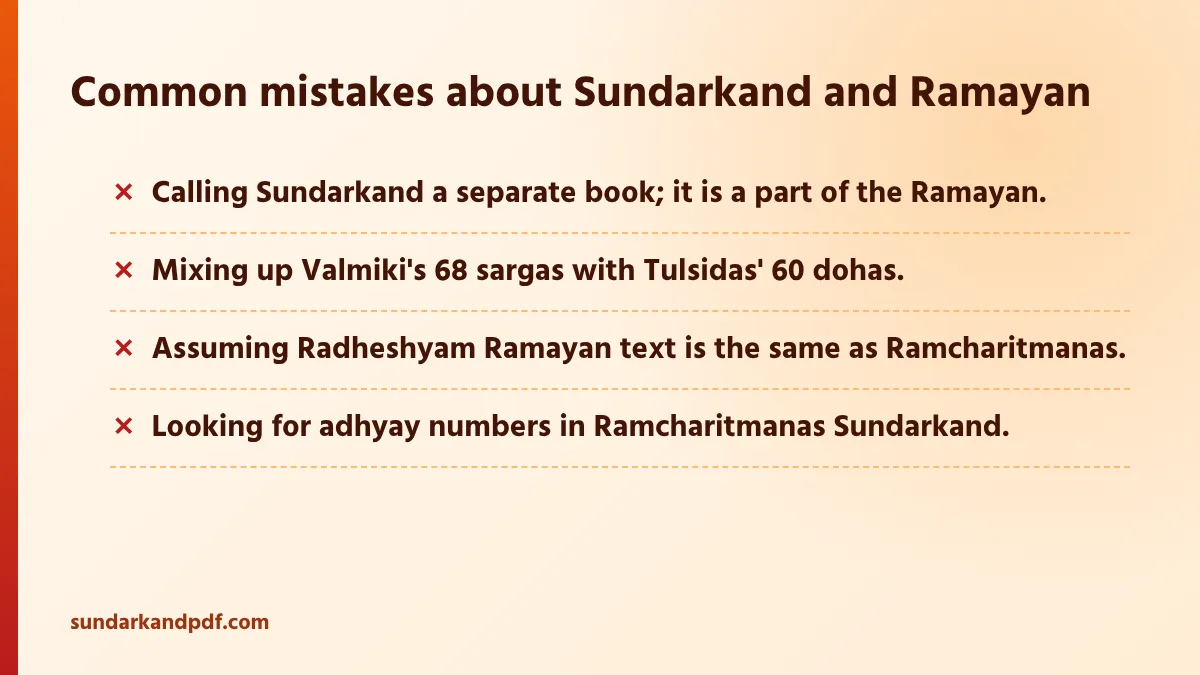
- Calling Sundarkand a separate book; it is a part of the Ramayan.
- Mixing up Valmiki’s 68 sargas with Tulsidas’ 60 dohas.
- Assuming Radheshyam Ramayan text is the same as Ramcharitmanas.
- Looking for adhyay numbers in Ramcharitmanas Sundarkand.
Frequently asked questions
What is Sundarkand?
Sundarkand is the fifth part (kand) of the Ramayan. It tells how Hanuman crossed the ocean to Lanka, found Sita, burned Lanka and returned with her message to Ram.
Who wrote Sundarkand?
Goswami Tulsidas wrote the Sundarkand of Ramcharitmanas in Awadhi in the 16th century. The original Sundara Kanda in Sanskrit is part of Valmiki Ramayan.
Which kand comes before and after Sundarkand?
Kishkindha Kand comes before Sundarkand, and Lanka Kand (Yuddha Kanda in Valmiki) comes after it.
How many chapters are in Sundarkand?
Ramcharitmanas Sundarkand has no chapters; it is marked by 60 dohas. Valmiki’s Sundara Kanda has 68 sargas.
Is Sundarkand part of Ramcharitmanas?
Yes, it is the fifth kand (pancham sopan) of Shri Ramcharitmanas.
Why is it called Sundarkand?
Traditions say it is named after Sundar mountain in Lanka, or because it is the beautiful chapter where the devotee Hanuman is the hero.
Conclusion
Sundarkand Ramayan is the fifth and most loved part of the Ramayan, the chapter of Hanuman’s courage and Sita’s hope. Read it in Tulsidas’ Awadhi or Valmiki’s Sanskrit; the journey is the same.
Next step: read how to do Sundarkand path at home step by step and begin on a Tuesday.